


For mid-market and SMB organizations, maximizing the return on their Workday investment is a continuous journey. While core FIN and HR modules handle daily operations, achieving deep, cross-functional reporting has traditionally presented a challenge.
Many finance leaders instinctively turn to external business intelligence (BI) systems like Power BI or Tableau to blend their operational data. However, for a growing business, this path often introduces significant IT complexity, security risks, and high maintenance costs. It also creates a dependency on IT to make (even small) changes. As a result of unfavorable response rates, this leads to the growth of shadow systems. Workday Prism Analytics, powered by the Workday Data Cloud, offers a powerful alternative that enables sophisticated, unified reporting directly within your secure Workday environment.
Breaking the HR and Finance Silo
In many organizations, headcount is viewed primarily as a line-item expense managed within HR. But for project-based and service-driven businesses, your people are the primary driver of revenue. I many other organizations, labor cost are the largest expense. To truly understand profitability, a CFO must connect workforce data directly with financial outcomes.
When financial ledgers and HR data live in separate silos, calculating project profitability or forecasting resource capacity becomes a manual, error-prone exercise in Excel. By bringing these datasets together, finance leaders can view headcount not just as a cost, but as a strategic driver tied directly to project billing, utilization, and margins.
Achieving this level of visibility requires pulling operational data into your financial ecosystem which is exactly where Prism Analytics excels.
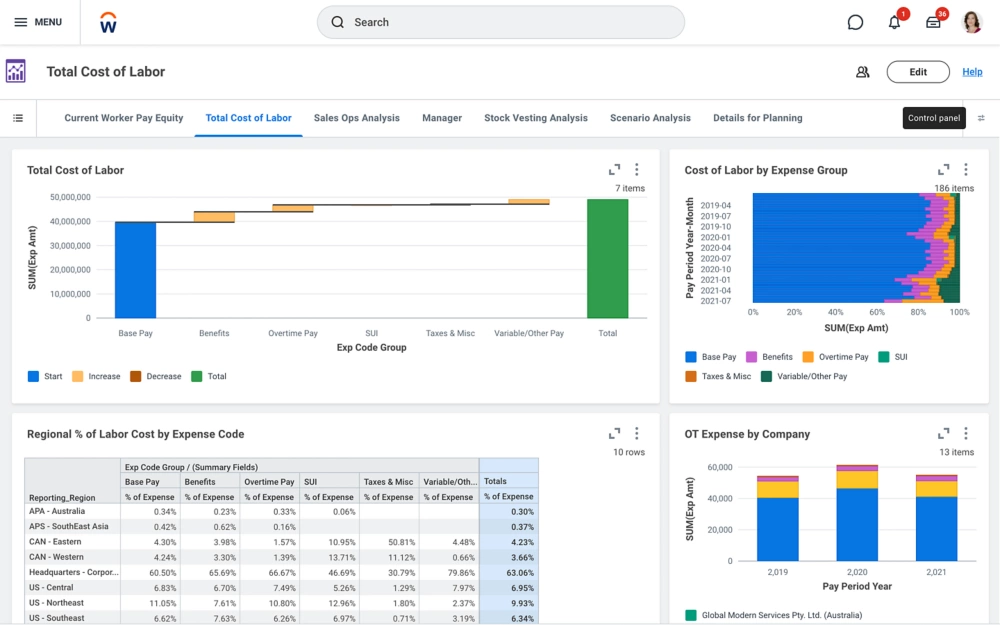
Why the Workday Data Cloud & Prism is better than External BI
While platforms like Power BI are highly capable, they require a substantial, ongoing IT footprint to integrate seamlessly with Workday and maintain the reporting library. You are shifting your expertise from functional to technical resources. By leveraging the Workday Data Cloud as your foundation, Prism Analytics provides a more streamlined, secure, and cost-effective approach for mid-market companies:
- Native Security & Governance: External BI tools require exporting sensitive HR and financial data out of Workday. To maintain compliance, IT teams must manually replicate Workday’s complex, row-level security model inside the external platform. Prism inherits Workday’s native security automatically, keeping your sensitive data fully protected.
- Reduced Integration TCO: Building and maintaining custom data pipelines to feed an external data warehouse is expensive. Industry data shows that year-one integration and pipeline maintenance costs for external BI tools can run into hundreds of thousands of dollars. Workday Data Connect allows you to bring external data (like CRM, point-of-sale, or operational feeds) directly into Workday, bypassing the need for a separate data warehouse.
- Actionable Insights in Context: Rather than switching between different platforms, your business leaders can view, analyze, and act on insights directly within the Workday user interface. This drives faster decision-making and higher user adoption.
Adopting a “Reporting First” Mindset (Without the Report Overload)
Unfortunately in most Workday implementations, reporting is the first item to get cut or deferred when timelines run tight. This “reporting last” trap leads to a common post-go-live frustration: “Why doesn’t my ledger match my custom dashboard?” or “Where are those beautiful reports I saw in the sales demo?”.
To prevent this, organizations must adopt a “reporting first” mindset. After all, the point of diligently capturing financial transactions is to have the ready for analytics and decision making. Designing for reporting doesn’t mean building more reports. In fact, doing so often leads to “report overload” and dashboard sprawl. True reporting bliss takes governance with a strategic approach:
- Define Clear Ownership: Establish a “gatekeeper” or a cross-functional reporting team (Finance, HR, and IT) to review and approve new report requests.
- Understand the Data Model: Document definitions and relationships of business objects and metrics so that every consumer can utilize them with confidence. Identify duplicates or ambiguities.
- Design for Decisions, Not Curiosity: Every report should answer a specific operational question or trigger a concrete action. If a requested report doesn’t drive a business decision, it shouldn’t be built.
- Establish a Lifecycle Policy: Audit your active reports quarterly. Retire dashboards that have low utilization to keep your user experience clean and your data trust high.
By building the foundation to support tools like Prism with strong governance from day one, you ensure that external data sources blend cleanly with core financial data, preserving a single, trusted source of truth.
The Boutique Advantage with Teamup9
Unlocking the power of Prism Analytics and the Workday Data Cloud does not require hiring a global system integrator with rigid methodologies and high overhead. In fact, large-scale firms often struggle to deliver the highly tailored, agile data modeling that mid-market organizations require.
At Teamup9, we believe in a different approach. As a boutique Workday partner, we focus on value over volume. We work alongside your admin team to design practical data pipelines, establish sustainable reporting governance, and help you strategically deploy Prism Analytics to maximize your ROI.
If you are ready to bridge the gap between HR and Finance and get more out of your Workday platform, let’s start a conversation. Reach out to Teamup9 today to learn how we can help you build a unified reporting strategy that fits your business.