

Workday Rising 2026 in Las Vegas delivered major announcements centered on intelligent automation, modernized user experiences, and unified data architecture. As these innovative capabilities make headlines, executives and business users will naturally push internal administrative teams to explore and adopt these features quickly.
However, system administrators and IT leaders must balance this enthusiasm with a practical question: How do we successfully evaluate and adopt these changes within our own environment while managing cost and governance?
Here is a look at the most significant updates from Rising and the key strategic considerations for your organization.
Modernizing User Experience with Sana and Self-Service
The shift toward the new Sana homepage experience is officially here. Sana offers an updated, visually streamlined interface designed to simplify navigation and surface contextual information to users. Many organizations will be reluctant to change such high-traffic digital real estate without a clear adoption strategy, wanting to ensure consistent messaging across all teams.
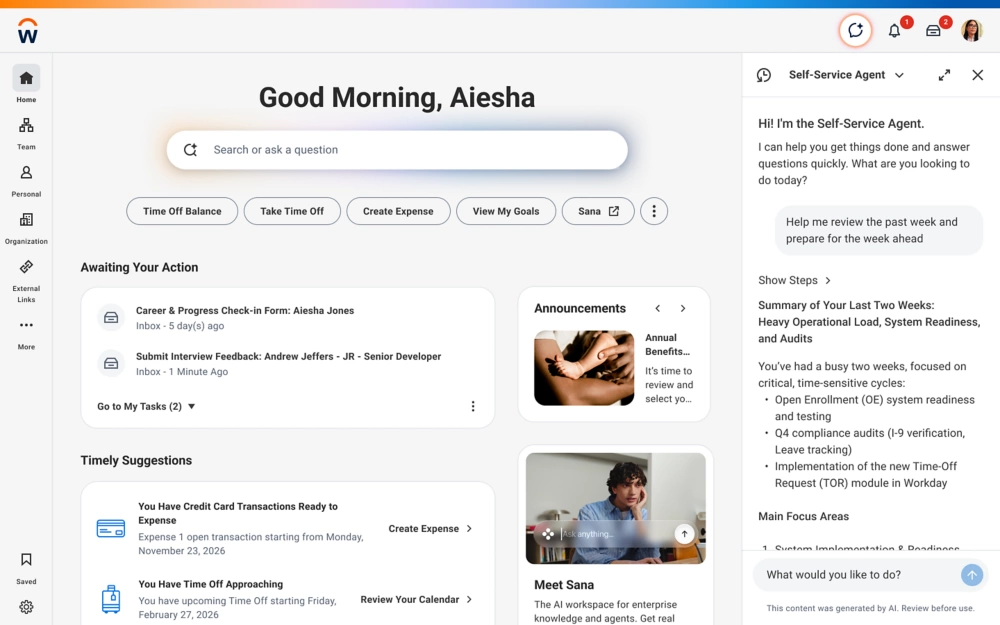
Alongside Sana, the new Self-Service Agent represents one of the most immediate, high-value opportunities for Workday users:
- Smart Search Replacement: It transforms the traditional search bar into a conversational interface that guides employees directly to relevant tasks and transactions
- Contextual Policy Integration: The agent can ingest company-specific policy documents, providing fast, accurate answers tailored to your organization’s business rules
- Workday Assistant Replacement: For organizations that have used the Workday Assistant, this functionality serves as a superior replacement that offers far greater configurability
Navigating your path to AI Agents, Data Cloud, and System Architecture
The expansion of AI across the platform introduces powerful features, alongside new administrative and commercial considerations that require careful planning:
- FlexCredits and AI Usage: AI Agents are defined by skills and instructions (configured using standard Markdown format) and managed within an internal Agent Registry. Every agent interaction consumes FlexCredits. Organizations must proactively budget FlexCredits consumption across any intended AI use case to prevent unexpected costs
- Agent System or Record: By registering Agents within Workday, it provides your team with visibility and control on their access rights, audit trail and credit consumption.
- Contractual Requirements : To access AI features, customers must sign a Universal Main Subscription Agreement(UMSA). An existing Innovation Services Agreement (ISA) will not suffice
- Configuration Agents: Demonstrations of automated tenant configuration and testing highlight the direction of platform management. While promising, adopting automated configuration workflows requires clear oversight to ensure compliance with internal governance standards
Turning Announcements into an Actionable Roadmap
Adopting new Workday capabilities is not just a technical upgrade. It requires thoughtful change management, budget alignment, and contract reviews. To maximize return on investment without introducing operational friction, organizations need a clear execution strategy.
Work with a partner on evaluation and roadmap adoption to bridge the gap between executive enthusiasm and practical execution. A dedicated partner helps you evaluate feature readiness, forecast FlexCredits usage, and build an effective adoption plan tailored to your specific business goals.
Partner with Teamup9
At Teamup9, we help organizations navigate Workday updates with confidence. From deployable Sana activation packages to comprehensive FlexCredit usage modeling and roadmap planning, our experts are here to ensure your tenant evolves seamlessly.
Ready to translate Workday Rising 2026 announcements into a practical strategy for your team? Contact Teamup9 today to schedule an evaluation workshop.