


Data‑driven decision‑making is the key factor separating companies that simply react from those that truly advance. For organizations running on Workday, the introduction of Workday Data Cloud in 2026 represents a pragmatic step forward in how we handle information. By bringing together Workday Prism Analytics, a curated Data Lake, and Live Data Query, Workday has created an ecosystem designed to break down the silos between HR, Finance, and external operational data.
The Three Pillars of the Data Cloud
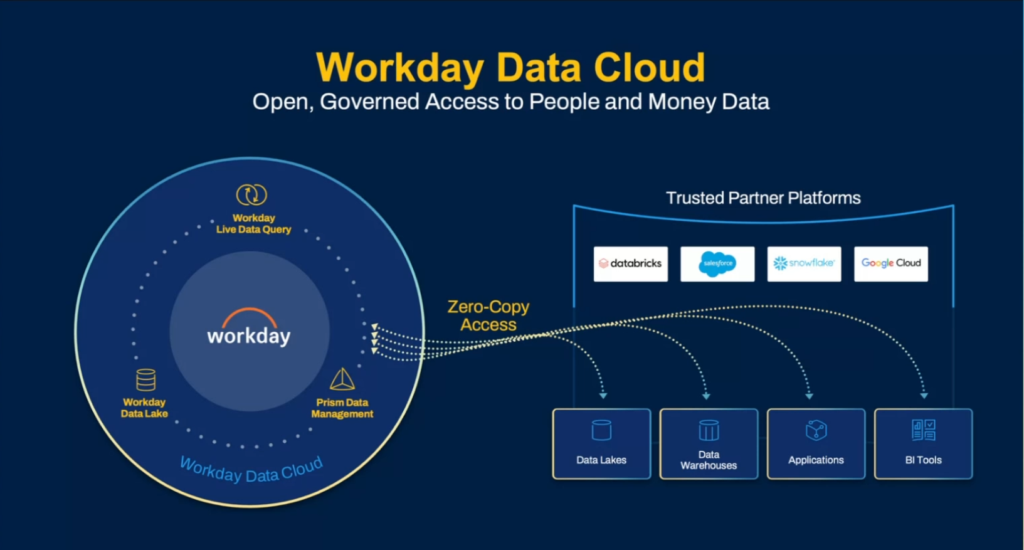
To understand the value of this new offering, it helps to look at the three core components that make it function:
- Workday Prism Analytics: This remains the “data hub” where you can ingest, transform, and blend high-volume data from any source
- Workday Data Lake: Built on open standards like Apache Iceberg, the Data Lake provides a secure, organized catalog of Workday objects. It acts as the central storage layer that allows for a “single source of truth” without duplicating data across multiple applications
- Workday Live Data Query: This is perhaps the most significant addition for technical teams. It provides direct SQL access to core business data, allowing users to query information in minutes rather than waiting for complex reports to run or integrations to sync
Practical Benefits for Workday Admin Teams
For those managing the tenant daily, the shift to a Data Cloud model simplifies many of the traditional “headaches” associated with data management. Instead of building and maintaining brittle ETL (Extract, Transform, Load) pipelines, admins can now leverage a zero-copy approach.
- Reduced Integration Complexity: By using zero-copy technology, data can be shared bidirectionally with platforms like Snowflake or Databricks without physically moving the files
- Security Inheritance: One of the strongest selling points is that the Workday Data Cloud adheres to the Workday Single Security Model. Permissions defined in your HCM or Financials modules automatically apply to the data cloud, ensuring that sensitive information remains protected
- Faster Time-to-Value: Administrators can deploy analytics solutions faster because the data is already “context-aware,” retaining its semantic meaning and relationships from the core system
- Scalability: The architecture is designed to handle massive volumes of operational data that would typically slow down a standard transactional system
Real-Time Security and Federated Access
The “zero-copy” philosophy isn’t just about speed; it’s a security strategy. In traditional setups, every time you export data to an external BI tool, you create a security risk and a potential version-control nightmare.
Workday Data Cloud addresses this by providing Federated Data access. This means when a finance professional runs a real-time forecast in an external tool, they are querying the data where it lives. Because the security rules are embedded at the core, the user only sees what their Workday role allows. This ensures compliance is maintained across the entire enterprise ecosystem without manual intervention.
Use Cases: Moving Beyond HR and Finance
The true power of this unified foundation is seen when you blend internal and external data. Consider these practical applications:
- Retail Optimization: A company can combine employee engagement scores from Workday with store performance data from an external POS system to identify which management styles are driving the highest sales
- Financial Scenario Planning: Finance teams can link internal budget data with real-time market risk metrics in Databricks to create more accurate, live forecasting models
- Retention Strategies: HR leaders can enrich performance reviews with actual productivity data (like sales quota attainment from Salesforce) to identify high-potential employees before they become a turnover risk
Availability and How to Prepare
Workday Data Cloud is moving into general availability throughout 2026. For organizations looking to adopt these features, preparation should start now. We recommend beginning with a thorough data cleansing of your legacy systems and identifying one high-value “quick win” use case—such as a specific cross-departmental report that currently requires manual spreadsheet work.
Transitioning to this model requires a shift in mindset from “managing reports” to “managing a data ecosystem.” By establishing clear governance and roles today, your team will be ready to hit the ground running when the tools become available in your tenant.
Conclusion
Workday Data Cloud is a sophisticated step toward a highly-connected enterprise. By removing the friction of moving data and maintaining the integrity of the Workday security model, it allows Admin teams to focus on strategy rather than maintenance.
At Teamup9, we specialize in helping organizations navigate these complex transitions. Whether you need help configuring your first Prism pipeline or architecting a long-term data strategy, our experts are here to ensure your Workday investment delivers maximum value.