

The transition from a Workday implementation project to “business as usual” is a critical juncture for any organization. Often, the initial business case focuses heavily on the deployment phase, leaving the long-term support model as an afterthought. However, Workday is a living ecosystem, it evolves with semi-annual updates, changing business requirements, and the constant need for better data insights.
To ensure the platform continues to deliver value, organizations need a robust production support strategy. Building a business case for these services requires moving beyond the mindset of “keeping the lights on” and focusing on strategic alignment and risk mitigation.
Finding the Balance: The Hybrid Support Model
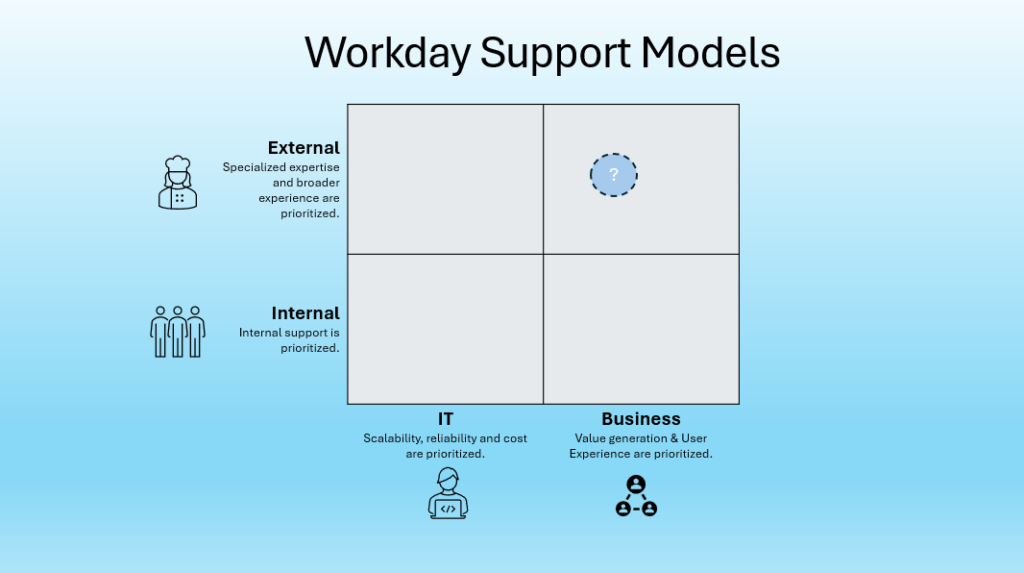
One of the most effective ways to manage a Workday environment is through a balanced support model that leverages both internal administrators and external expertise. An internal team is invaluable for their deep understanding of company culture, internal processes, and stakeholder relationships. They act as the primary bridge between the business and the technology.
However, relying solely on internal resources can lead to bottlenecks, especially during peak periods like annual enrollment or year-end financial closing. By integrating external production support, organizations gain access to a broader pool of specialized knowledge such as complex integration troubleshooting or niche module configuration without the overhead of full-time specialized hires. This hybrid approach ensures that internal teams can focus on high-value business engagement while the external partner handles the technical heavy lifting and tactical maintenance.
Shifting Focus: From Ticket Counts to Business Outcomes
Traditionally, support services are measured by ticket volume and resolution speed. While these metrics are important for tracking operational efficiency, they do not tell the whole story of the system’s health or its impact on the organization. A compelling business case should shift the narrative toward business outcomes.
Instead of asking, “How many tickets did we close?” organizations should ask:
- How much did we reduce manual work through automation this quarter?
- Are we adopting new Workday features (such as AI Agents) at a rate that keeps us competitive?
- Has our “time-to-report” improved for executive leadership?
- Are we able to provide clear data to leadership that builds trust and minimizes reconciliation?
- Are we recruiting talent effectively?
By focusing on outcomes, production support becomes a driver of continuous improvement rather than a reactive cost center. This perspective demonstrates to stakeholders that support is an investment in organizational agility.
The Financial Value of Risk, Experience, and Data
To gain executive buy-in, it is essential to quantify the financial implications of a well-supported system. Going up against revenue-oriented projects can be daunting as the financial value is not always that obvious. Besides, reduced manual effort, you should consider looking at three key areas:
- Risk Avoidance: The cost of a compliance failure or a security breach far outweighs the cost of proactive support. Ensuring that security roles are correctly audited and that tax updates are applied accurately protects the organization from significant legal and financial exposure.
- User Experience (UX): Poor system performance or confusing workflows lead to “shadow systems” and manual workarounds. It can cost an organization substantial money to support multiple systems that perform the same job. If an optimized UI saves 10 minutes per week for 1,000 employees, the cumulative productivity gain is substantial. A seamless UX also increases self-service adoption, reducing the burden on HR and Finance desks.
- Real-time Analytics: Clean, well-governed data is the foundation of strategic decision-making. Production support ensures that integrations are functioning and data remains consistent, providing leaders with the real-time insights needed to pivot in a changing market.
Conclusion and the Teamup9 Approach
Building a business case for Workday production support is about more than just maintaining software; it is about protecting an investment and empowering a workforce. A successful model balances internal knowledge with external scale, focuses on meaningful outcomes, and prioritizes the financial stability that comes from rigorous risk management and data integrity.
At Teamup9, we believe that support should be as unique as the organization it serves. We move away from rigid, one-size-fits-all AMS constructs, preferring to co-design a governance model that aligns with your internal standards. Founded in 2016 with a mission to improve client ROI, Teamup9 provides the deep technical expertise and strategic partnership required to turn your Workday environment into a true engine for growth.